
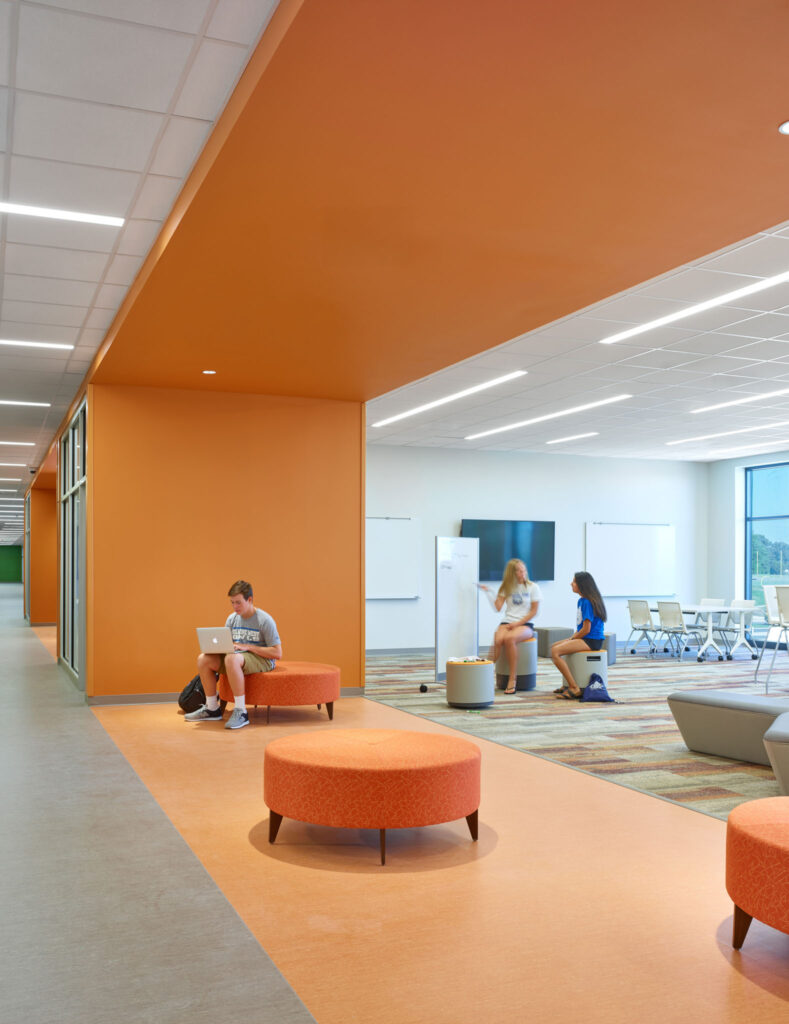
As the education field places increasing emphasis on student-centered learning and the development of future-ready skills, innovative learning spaces have grown in popularity in recent decades. These spaces are a departure from the traditional “cells and bells” design, instead featuring spatial groupings of varied and flexible educational zones, which accommodate diverse methods of teaching and learning1, 2, 3. When these spaces are designed, it is commonly assumed the associated instructional practices will necessarily follow. In other words, If we build it, they will teach. While many schools are successful in achieving this synergy, research suggests there is not a direct causal relationship between the learning space design and practices within it. Rather, numerous mediating factors appear to influence how teachers use these spaces, including the nature of the transition to the space, perceived risk and reward, and pedagogic tensions at various levels.
The successful transition to a new learning facility begins at design. Involving teachers and instructional leaders in the design process not only ensures the space meets their needs, but also may help to ease the transition and promote productive use of the new space. In fact, research finds that when teachers are co-designers of an innovative learning space, they not only experience the space as more “fit”, but also develop a sense of ownership and act as stewards of the space, eagerly sharing their knowledge and encouraging the desired pedagogical practices among peers2.
Read our blog, “Navigating Change in New Learning Environments,” to learn more about how to successfully navigate the transition to a new facility.
When school leaders acknowledge and help to mitigate the risks teachers perceive – whether it be the time needed to adjust their practice or privacy from their peers – teachers may feel empowered to lean into the uncertainty and ultimately build confidence in adapted approaches.
As teachers transition into innovative learning spaces, they may face tensions in their pedagogical practices, which further complicate their willingness or ability to align their approach with the affordances of the new environment. These tensions may exist between teachers and systemic factors, other teachers, their own existing practice, or the space.
When designing a new innovative learning space, designers and educators alike frequently presume that if the space promotes flexibility and student-centered practices, teachers will be influenced to adjust their pedagogical approach to match. Research demonstrates that while this goal can be met, it rarely happens automatically as many mediating factors influence if a teacher is willing or able to shift their practice to meet the expectations in the new space. When the stakeholders involved have full awareness of this investment, and commit to it with fidelity, both students and staff stand to benefit from the engagement that accompanies a true innovative learning environment.
Research Support
Share this post:
References
1: Frelin, A. Grannäs, J., & Woolner, P. (2025). Comparing Teachers’ experiences of innovative and traditional learning spaces: What’s going on? Learning Environments Research. https://doi.org/10.1007/s10984-025-09550-3
2: Baars, S., Schellings, G.L.M., Joore, J. P., & van Wesemael, P. J. V. (2022). Physical learning environments’ supportiveness to innovative pedagogies: students’ and teachers’ experiences. Learning Environments Research, 26, 617-659. https://doi.org/10.1007/s10984-022-09433-x
3: Bradbeer, C., Mahat, M., Byers, T., & Imms, W. (2019). A systematic review of the effects of innovative learning environments on teacher mind frames. Innovative Learning Environments and Teacher Change. http://www.iletc.com.au/publications/reports
4: French, R. (2021). School change: Emerging findings of how to achieve the “buzz”. In W. Imms & T. Kvan (Eds.), Teacher Transition into Innovative Learning Environments (pp. 61-72). Springer. https://doi.org/10.1007/978-981-15-7497-9_6

5: Bøjer, B. (2021). Creating a space for innovative learning: The importance of engaging the users in the design process. In W. Imms & T. Kvan (Eds.), Teacher Transition into Innovative Learning Environments (pp. 33-46). Springer. https://doi.org/10.1007/978-981-15-7497-9_6

6: Jones, T. K. & La Fevre, D. M. (2021). Increasing teacher engagement in innovative learning environments: Understanding the effects of perceptions of risk. In W. Imms & T. Kvan (Eds.), Teacher Transition into Innovative Learning Environments (pp. 73-83). Springer. https://doi.org/10.1007/978-981-15-7497-9_6
7: Saltmarsh, S., Chapman, A., Campbell, M., & Drew, C. (2014). Putting “structure within the space”: Spatially un/responsive pedagogic practices in open-plan learning environments. Educational Review. http://dx.doi.org/10.1080/00131911.2014.924482
8: Data referenced from Post Occupancy Evaluations conducted by Hollis + Miller Architects at three recently built middle schools.
9: Byers, T. (2021). What does teaching and learning look like in a variety of classroom spatial environments? In W. Imms & T. Kvan (Eds.), Teacher Transition into Innovative Learning Environments (pp. 187-201). Springer. https://doi.org/10.1007/978-981-15-7497-9_6

10: Leighton, V. (2021). Envisaging teacher spatial competency through the lenses of situated cognition and personal imagination to reposition it as a professional classroom practice skill. In W. Imms & T. Kvan (Eds.), Teacher Transition into Innovative Learning Environments (pp. 249-275). Springer. https://doi.org/10.1007/978-981-15-7497-9_6